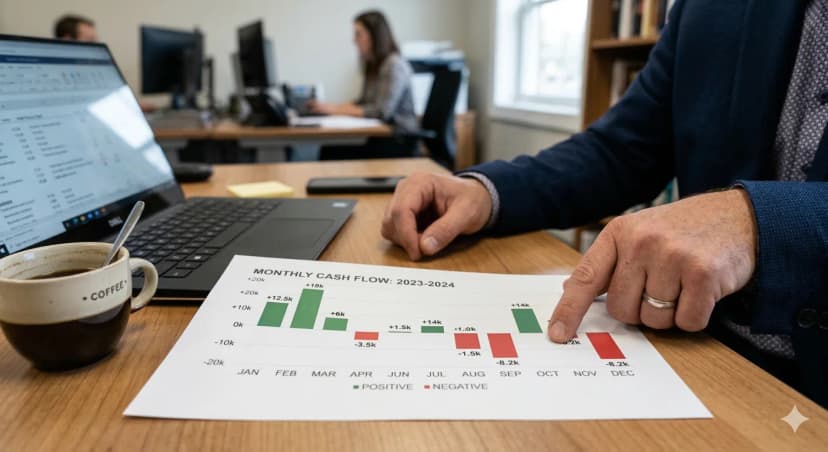
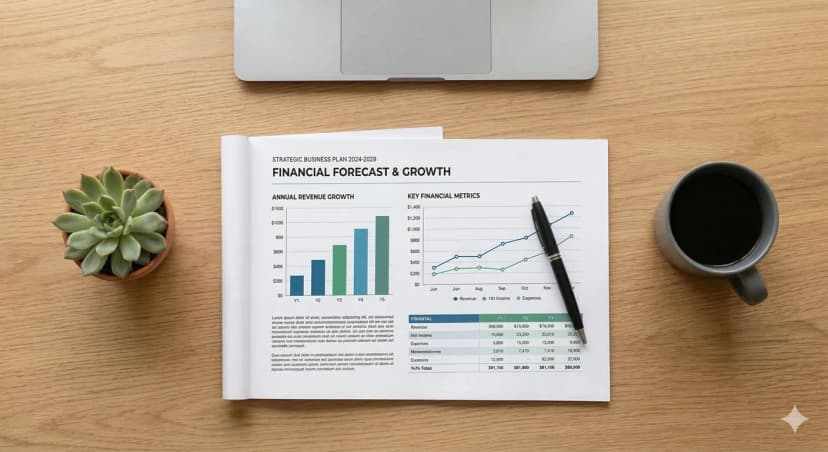
Pro forma financial statements are forward looking financial documents that project what your business will look like financially over the next 1-5 years. Every SBA lender will ask for them, and investors won't take a meeting without them. If you're running a business without them, you're flying blind on cash.
The word "pro forma" is Latin for "as a matter of form," but there's nothing ceremonial about these documents. They're the difference between knowing you'll run out of cash in August and finding out in August.
This guide explains the three core pro forma statements, how they connect, and how to build them. They're a key section of any business plan, and the executive summary should highlight the most important numbers from them.
The Three Pro Forma Statements
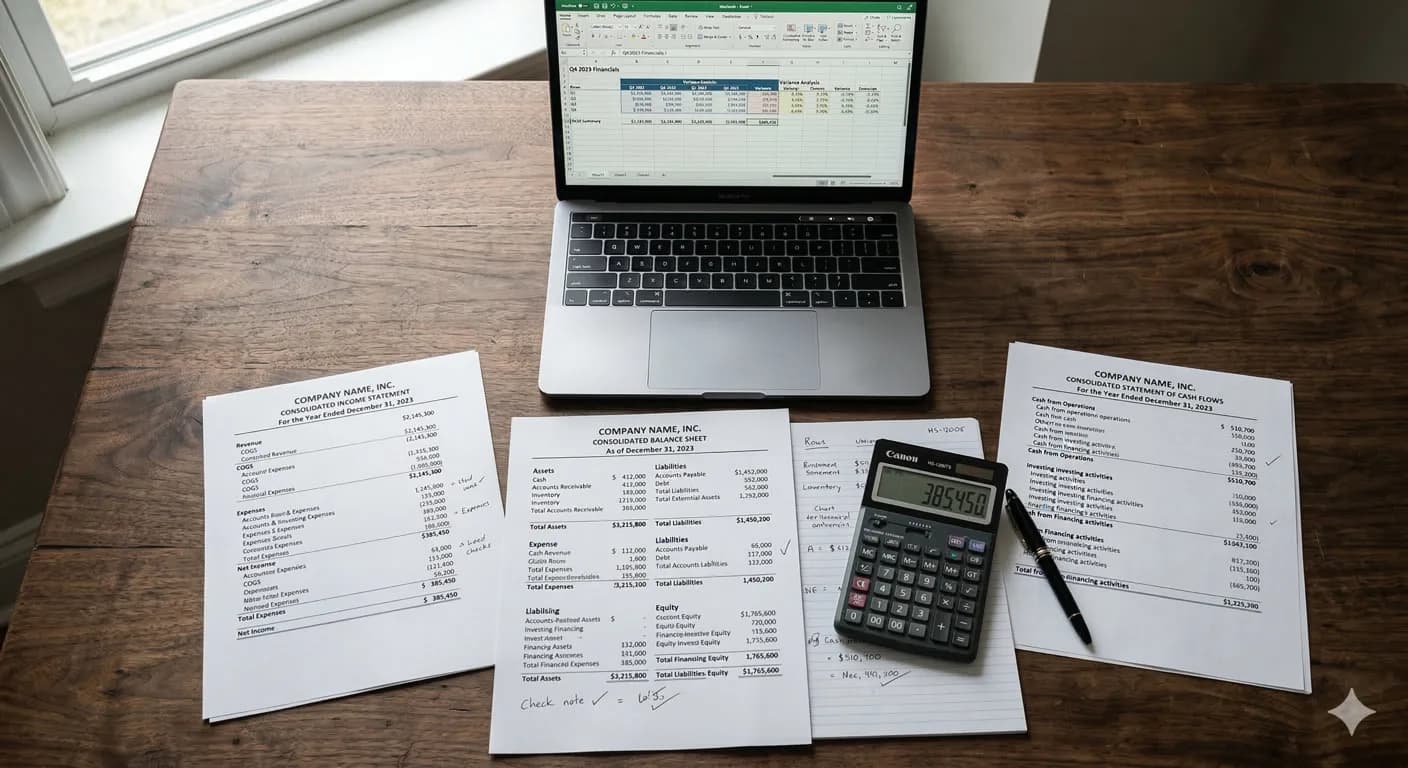
Every set of pro forma financial statements includes three documents. They each answer a different question, and they're useless in isolation.
Pro Forma Income Statement
What it answers: Will the business be profitable?
The pro forma income statement (also called a projected P&L) shows expected revenue minus expected expenses over a specific period. It starts with revenue at the top and works down through costs to arrive at net income.
A simplified structure:
| Line Item | Year 1 | Year 2 | Year 3 |
|---|---|---|---|
| Revenue | $500,000 | $750,000 | $1,000,000 |
| Cost of Goods Sold | $175,000 | $255,000 | $330,000 |
| Gross Profit | $325,000 | $495,000 | $670,000 |
| Operating Expenses | $240,000 | $310,000 | $390,000 |
| Net Income | $85,000 | $185,000 | $280,000 |
The income statement tells you whether the business model works on paper. But it doesn't tell you when money actually hits your bank account. That's what the cash flow statement is for.
Pro Forma Cash Flow Statement
What it answers: Will the business have enough cash to operate?
A business can be profitable and still run out of cash. This happens all the time: you invoice a client $50,000 in March, but they don't pay until May. Your income statement shows the revenue in March. Your bank account disagrees.
The cash flow statement tracks actual cash movement: when it comes in and when it goes out. It's organized into three sections:
- Operating activities: cash from day to day business (customer payments minus supplier payments, payroll, rent)
- Investing activities: cash spent on or received from assets (equipment purchases, property sales)
- Financing activities: cash from or to lenders and investors (loan proceeds, loan repayments, equity investments)
The bottom line is your ending cash balance for each period. If that number goes negative at any point, you have a problem that your income statement won't show.
For construction companies, restaurants, and other businesses with irregular billing cycles, the cash flow statement is often more important than the income statement. Our cash flow projections guide covers how to build one step by step.
Pro Forma Balance Sheet
What it answers: What is the business worth at a specific point in time?
The balance sheet is a snapshot. It shows three things:
- Assets: what the business owns (cash, equipment, accounts receivable, inventory)
- Liabilities: what the business owes (loans, accounts payable, credit lines)
- Equity: the difference between assets and liabilities (what the owners actually own)
The fundamental rule: Assets = Liabilities + Equity. Always. If your projected balance sheet doesn't balance, something in your model is wrong.
Lenders pay close attention to the balance sheet because it reveals leverage. If your business has $500,000 in assets and $450,000 in liabilities, you're highly leveraged and a risky borrower. If you have $500,000 in assets and $100,000 in liabilities, you have a cushion.
How the Three Statements Connect
This is where most people get confused, and where spreadsheet models break.
Net income from the income statement flows into the equity section of the balance sheet (retained earnings). Cash from the cash flow statement becomes the cash line on the balance sheet. Asset purchases on the balance sheet show up as investing activities on the cash flow statement. Depreciation on the income statement reduces asset values on the balance sheet but adds back to cash flow (because it's a noncash expense).
Change one assumption and it cascades through all three documents. This is why building pro forma statements in disconnected spreadsheets is a recipe for errors. The statements need to be linked.
Who Needs Pro Forma Financial Statements
Anyone applying for a loan, raising investment, or planning a major expansion. Banks use your projections to calculate debt service coverage ratios (our bank loan guide covers what lenders look for). Investors want to see when you'll stop burning cash and what their return looks like if you hit your numbers. And even without external stakeholders, projections help you spot cash crunches months before they happen.
How to Build Them
Start with Revenue
Start with revenue, and build it from the bottom up. Top down projections ("we'll capture 1% of the market") are what investors throw in the trash. Bottom up means: number of customers (or units, or projects) multiplied by price. "200 customers at $5,000 average annual value = $1,000,000" is a projection. "We'll do $1M" is a wish.
Layer in Costs
Split costs into two categories:
Variable costs scale with revenue: materials, shipping, transaction fees, sales commissions. Express these as a percentage of revenue based on industry benchmarks or your historical data.
Fixed costs stay constant regardless of revenue: rent, salaries, insurance, software subscriptions. These are easier to project because they're often contractual.
Model the Timing
Revenue recognition and cash collection are different events. If your payment terms are net-30, your cash flow statement should reflect that 30-day lag. If you pay suppliers on delivery but collect from customers 60 days later, your cash flow model needs to show the gap.
Project the Balance Sheet
Start with your opening balance sheet (assets, liabilities, and equity on day one). Then let the income statement and cash flow statement drive changes period by period. New equipment purchases increase assets and decrease cash. Loan payments decrease liabilities and decrease cash. Retained earnings from the income statement increase equity.
Stress Test the Numbers
Run at least two scenarios beyond your base case:
Conservative scenario: revenue 20-30% below target, costs 10% above target. Can you still cover operating expenses and debt payments?
Growth scenario: revenue hits 120-150% of target. Do you have the capacity, cash, and team to handle it, or does growth create a cash crunch from scaling costs?
If your business fails the conservative scenario, your projections are too optimistic.
Common Mistakes
Revenue projections with no supporting math. "We'll grow 50% per year" with no explanation of how. Show the customer acquisition assumptions behind every revenue number.
Forgetting working capital. Growing businesses consume cash. If revenue doubles, your accounts receivable and inventory likely double too, and that cash has to come from somewhere.
Flat expense assumptions. Rent stays the same, but payroll doesn't. Insurance premiums increase annually. Software subscriptions raise prices. Build in realistic cost escalation.
Not linking the statements. If your income statement shows a $100,000 profit but your cash flow statement shows a $50,000 decrease in cash, you need to be able to explain why. Both can be correct (due to asset purchases or debt repayment), but they must reconcile.
Related Guides
-
Business Plan Examples: 15+ Real Plans by Industry — The complete guide for this topic
-
Business Proposal Template: Free Examples & How to Write One — The complete guide for this topic
-
Marketing Plan Template: Free Download with Examples — The complete guide for this topic
-
Income Statement Template: Free Excel Download with Examples — The complete guide for this topic
-
Business Budget Template: Free Excel Download for Startups — The complete guide for this topic
Build Your Pro Forma Statements
Building linked pro forma financial statements from scratch in a spreadsheet takes days of modeling and is easy to get wrong. PlanArmory's pro forma generator builds all three statements from your business inputs: projected income statement, cash flow statement, and balance sheet with 5-year projections.