Every bank loan starts with the same question: do you have a business plan?
It doesn't matter if you're applying for a $10,000 line of credit or a $500,000 SBA loan. Lenders want a written document that proves your business can generate enough revenue to pay them back. No plan, no meeting.
Most entrepreneurs don't know what banks actually look for. They write 40 pages of vision statements when what the loan officer really wants is cash flow projections and a clear explanation of how the money will be used.
This guide breaks down exactly what goes into a business plan for a bank loan, section by section, so your application doesn't end up in the rejection pile.
What Banks Check Before They Even Read Your Plan
Before a loan officer opens your business plan, they've already screened you on three things:
Personal credit score. Most banks want 680 or higher for conventional loans. SBA loans can go as low as 650, but below 700 you'll face higher interest rates and more scrutiny on every other part of your application.
Time in business. Banks strongly prefer businesses with two or more years of operating history. Startups can still get funded, but the plan needs to work harder to prove viability. We cover startup specific strategies below.
Debt service coverage ratio (DSCR). This is the number that matters most. DSCR equals Net Operating Income divided by Total Debt Service. Banks want at least 1.25, meaning your business generates $1.25 for every $1.00 in loan payments. Below 1.0 means you can't cover the payments. Your financial projections need to clearly demonstrate a healthy DSCR.
Collateral. Banks want to know what they can recover if you default. Real estate, equipment, inventory, and accounts receivable all count. Most small business loans also require a personal guarantee from owners with 20% or more equity.
If you pass these initial screens, the business plan is what closes the deal. It turns "maybe" into "approved."
Why Banks Require a Business Plan
Banks are not investors. They don't care about your disruption narrative or your ten year vision. They care about one thing: will you pay them back?
A business plan for a bank loan answers that question with evidence. It proves you've done the math. The lender needs to see that your cash flow covers loan payments, that you know exactly where the money goes, and that your revenue model isn't wishful thinking.
According to the Federal Reserve's 2024 Small Business Credit Survey, only 41% of loan applicants received all the funding they requested. The rest were partially funded or denied entirely, and incomplete applications were a leading reason. Confidence doesn't get underwritten. Data does.
What to Include in Your Business Plan for a Bank Loan
The structure is standard. The difference is emphasis: financials carry more weight than any other section. A bank loan business plan is not a pitch deck. It's a risk assessment tool.
Here's what lenders want to see in each section.
Executive Summary
The first page the loan officer reads, and often the only one they read closely. Our executive summary guide covers exactly what to include and what to skip.
Keep it to one page. Cover these six points:
- What your business does and who it serves
- How long you've been operating (or your relevant experience if you are launching)
- Your revenue model and current revenue (if applicable)
- The exact loan amount you're requesting
- Specifically how the funds will be used
- How and when you'll repay the loan
Write the executive summary last, after you've completed every other section. It should read like a summary, not a teaser.
Company Description
Your business structure (LLC, S Corp, sole proprietorship), founding date, location, number of employees, and what problem you solve.
Banks favor businesses with a track record. Include specifics that demonstrate stability: years of operation, revenue trends, customer retention rates, key contracts, or repeat business percentages. If you operate from a commercial lease, mention the lease term remaining.
For businesses with multiple owners, list every person with their ownership percentage. The bank will run background and credit checks on anyone holding 20% or more.
Market Analysis
This is where most DIY plans lose credibility. Banks don't want to hear that your market is "huge and growing." They want evidence you understand who your customers are and whether enough of them exist to support your revenue projections.
Include:
- Total Addressable Market (TAM) with a credible source (Census Bureau, IBISWorld, trade associations). Our TAM SAM SOM guide explains how to calculate these correctly.
- Target customer profile with demographics, buying behavior, and average transaction value
- 3 to 5 direct competitors with an honest assessment of how you differentiate
- Industry trends that support your timing and growth assumptions
- Local market conditions if your business serves a geographic area
A SWOT analysis showing you've honestly evaluated your strengths, weaknesses, opportunities, and threats adds credibility. Banks respect founders who acknowledge risks and have plans to mitigate them.
Products, Services, and Pricing
Describe what you sell, your pricing structure, and your gross margins. Then explain how customers find you and what your sales cycle looks like.
A bank needs to believe your revenue projections are achievable. That means you need a plausible customer acquisition strategy with realistic conversion rates. If you're projecting $600,000 in Year 1 revenue but your marketing plan is "word of mouth," expect questions.
Include unit economics if possible. For example: "Average customer lifetime value is $3,200, customer acquisition cost is $180, with a 6 month payback period." This kind of detail tells the bank you understand your business deeply.
Financial Projections (The Most Important Section)
This is the section that makes or breaks a loan application. Everything else in your plan supports the story told by your numbers. Lenders want to see:
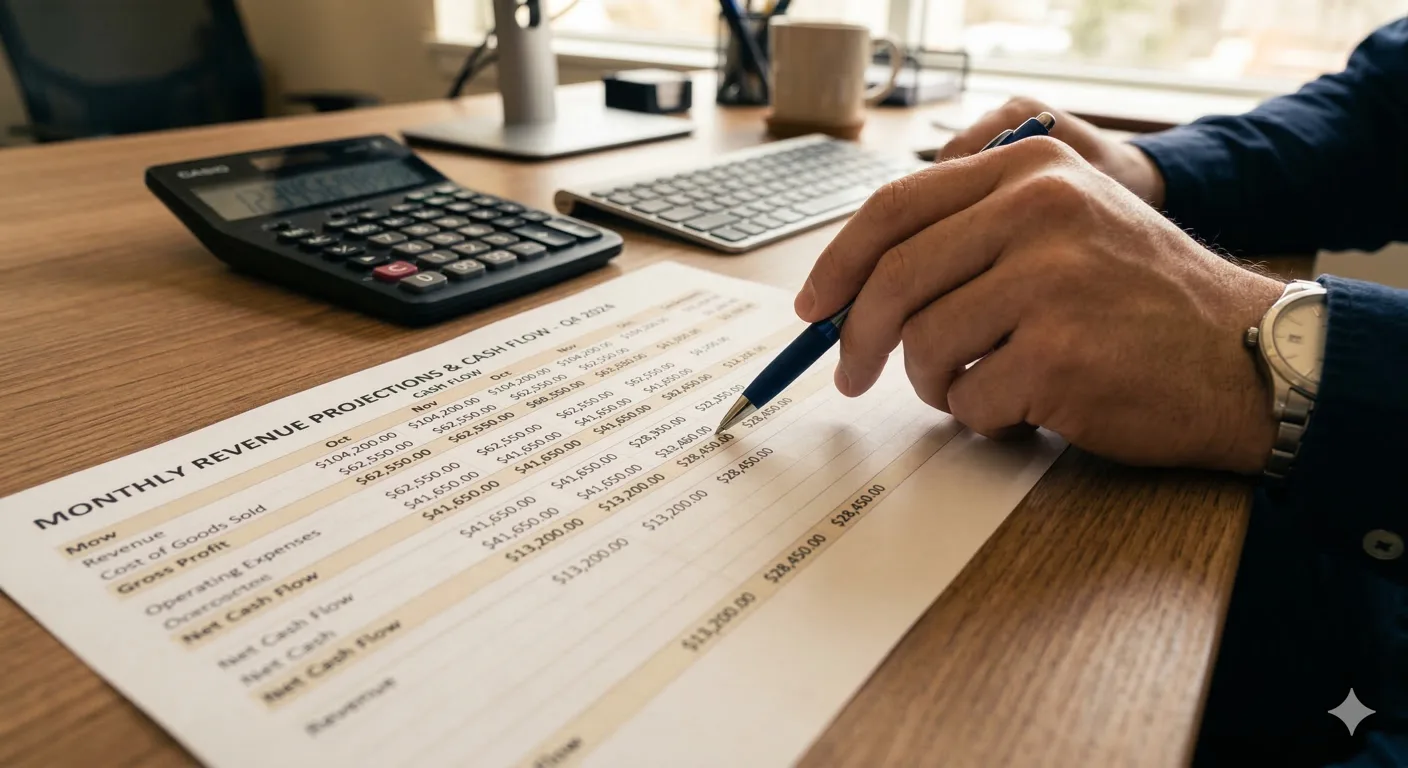
Income statement (profit and loss). Projected monthly for Year 1, annually for Years 2 through 5. Show revenue, cost of goods sold, gross profit, operating expenses broken down by category, and net income. If you're an existing business, include 2 to 3 years of historical P&L alongside your projections.
Cash flow statement. This matters more than your income statement for a loan application. Banks want to see when money comes in and when it goes out, month by month. Seasonal businesses need to show how they'll cover loan payments during slow months.
Balance sheet. Assets, liabilities, and owner's equity. This gives the bank a snapshot of your business's financial health and shows how the loan will change your debt structure.
Breakeven analysis. The point where revenue equals total costs. Banks want to know you understand your fixed and variable costs and can identify the minimum sales volume needed to stay afloat.
Debt service coverage ratio. Calculate this explicitly. Show that after all operating expenses, your business generates at least 1.25x the annual loan payment. This single number is often the deciding factor.
Our pro forma financial statements guide explains how the income statement, cash flow statement, and balance sheet connect, and our financial projections tool generates all three automatically based on your business details.
Key rules for bank ready projections:
- Base every number on an assumption you can explain. "250 customers x $2,000 average contract = $500,000" beats a revenue number with no explanation.
- Use conservative estimates. Banks have seen thousands of plans and know what reasonable growth looks like. 15 to 25% annual growth is credible for most industries. 300% growth with no explanation destroys credibility.
- Show sensitivity analysis. What happens if revenue comes in 20% below projections? Can you still cover payments? This demonstrates financial sophistication.
- If you're an existing business, your projections should align with your historical trajectory. A business growing 8% per year that suddenly projects 50% growth needs a very compelling explanation.
Funding Request
State the exact loan amount, the loan type you're pursuing, and provide a line item breakdown of how funds will be used. Vague requests are a red flag.
A strong funding request looks like this:
- Loan amount: $150,000
- Loan type: SBA 7(a) term loan, 10 year term
- Use of funds:
- Equipment purchase: $65,000
- Inventory buildout: $35,000
- Leasehold improvements: $30,000
- Working capital (first 6 months): $20,000
- Proposed repayment: Monthly payments from operating cash flow, beginning month 2
Every dollar should be accounted for. "Working capital" is acceptable for a portion, but the majority should be tied to specific expenditures.
Collateral and Personal Guarantees
List what you're putting up to secure the loan with estimated current values:
- Real estate (include appraised value if available)
- Equipment (list major items individually)
- Inventory
- Accounts receivable
- Personal assets (if offering a personal guarantee)
Most small business loans require a personal guarantee from any owner with 20% or more equity. This means your personal assets are on the line if the business can't repay. Banks view the willingness to personally guarantee as a sign of confidence in your business.
Supporting Documents
Your plan alone isn't enough. Banks will also require:
- Personal and business tax returns (2 to 3 years)
- Personal financial statement for each owner
- Business bank statements (6 to 12 months)
- Existing debt schedule listing all current obligations
- Business licenses, permits, and registrations
- Commercial lease agreements
- Articles of incorporation or organization
- Accounts receivable and payable aging reports (if applicable)
Prepare these before your meeting. Having them ready signals professionalism and speeds up the process.
If You're a Startup With No Revenue History
Startups face a harder path, but banks fund them regularly, especially through SBA microloans and community development financial institutions (CDFIs).
Your plan needs to compensate for the missing track record:
Emphasize founder experience. If you've worked in the industry for a decade, that's your substitute for business history. Detail your relevant skills, prior roles, certifications, and any industry relationships.
Show early traction. Letters of intent, signed contracts, pre orders, pilot program results, or even a waitlist. Anything that proves market demand beyond your opinion.
Provide a detailed month by month plan for Year 1. Monthly projections with specific milestones: "Month 3: first 10 paying customers. Month 6: break even on operating expenses. Month 9: begin loan repayment from cash flow."
Include a personal financial statement. Startups can't show business revenue, so banks evaluate the owner's personal finances more closely. A strong personal balance sheet with savings to cover 3 to 6 months of personal expenses adds confidence.
Consider starting smaller. A $25,000 SBA microloan has a much higher approval rate for startups than a $250,000 term loan. Prove the concept, build history, then come back for more.
Mistakes That Get Loan Applications Rejected

No financial projections (or unrealistic ones). The single biggest reason plans get rejected. If your plan has 20 pages of market analysis and one page of financials, you've got it backwards. For a bank loan, financials should be the most detailed section.
No clear use of funds. "We need money to grow" is not a funding request. Banks need a line item breakdown showing exactly where every dollar goes.
Ignoring the competition. Writing "we have no competitors" is the fastest way to lose credibility. Every business has competitors, even if they're indirect ones.
Overly optimistic projections. Projecting that your new restaurant will do $2 million in Year 1 when the average independent restaurant does $700,000 tells the bank you don't understand your industry.
No explanation of assumptions. Every number in your projections should trace back to a stated assumption. "Revenue: $500,000" is weak. "500 customers at $1,000 average annual spend, based on competitor benchmarks and our pilot results" is strong.
Inconsistent numbers. If your executive summary says you need $200,000 but your funding request says $175,000, the bank notices. Review your entire plan for consistency before submitting.
Missing personal financial information. Banks evaluate the owner as much as the business. Omitting your personal financial statement, credit history context, or existing obligations raises questions about what you're hiding.
SBA Loans vs. Conventional Bank Loans
The plan structure stays the same, but SBA loans demand more documentation and detail:
| Requirement | Conventional Loan | SBA Loan |
|---|---|---|
| Business plan | Required | Required (more detailed) |
| Personal financial statement | Usually required | Required for all 20%+ owners |
| Business tax returns | 2 years | 3 years |
| Credit score minimum | 680+ typical | 650+ (varies by lender) |
| Personal guarantee | Often required | Always required for 20%+ owners |
| Background check | Varies | Required (SBA Form 1919) |
| Debt schedule | Usually required | Always required |
| Approval timeline | 2 to 4 weeks | 4 to 8 weeks |
SBA lenders review your plan on behalf of the government, which means more scrutiny at every step. The trade off is worth it: lower down payments, longer repayment terms, and capped interest rates.
For the full breakdown, see our guide on SBA business plan templates.
How to Prepare for the Bank Meeting
Your plan gets you the meeting. Your preparation gets you the approval.
Know your numbers cold. The loan officer will ask about your DSCR, gross margins, biggest expense categories, and growth assumptions. If you have to flip through pages to answer, you lose confidence points.
Bring two copies of everything. Your plan, tax returns, financial statements, and supporting documents. Physical copies, organized in a folder or binder. Digital copies on a USB drive as backup.
Prepare for "what if" questions. What if revenue drops 30%? What if your biggest customer leaves? What if construction costs run over? Having thoughtful answers to downside scenarios demonstrates that you've stress tested your plan.
Be honest about weaknesses. If your credit score took a hit three years ago, address it proactively. If you lost a major client last year, explain what you've done to diversify. Banks respect transparency and penalize surprises discovered during due diligence.
The Fastest Way to Create a Bank Ready Business Plan
Write it yourself: 40 to 80 hours of research, financial modeling, and writing. This makes sense if you have a complex business or a loan request above $500,000 where lenders expect deep personal involvement.
Hire a consultant: $2,000 to $10,000 and 2 to 8 weeks. Worth it for complex deals above $1M or situations where you need a financial advisor's credibility attached to your application.
Use an AI business plan generator: PlanArmory generates a complete, bank ready plan with financial projections in about 60 seconds. It includes every section banks expect: executive summary, market analysis, competitive positioning, 5 year financials, and a funding request. You answer seven questions about your business and get a professional document you can take straight to the bank.
Create your bank ready business plan for free →
Frequently Asked Questions
How long should a business plan for a bank loan be?
Most bank ready business plans run 15 to 25 pages, excluding appendices. The financial projections section alone may be 5 to 8 pages. Focus on substance over length. A tight 15 page plan with solid financials beats a padded 40 page plan every time.
Can I get a bank loan without a business plan?
For very small loans (under $10,000) or lines of credit secured by personal assets, some banks may not require a formal plan. For any term loan, SBA loan, or unsecured credit above $25,000, you'll need one. Even when not strictly required, having a plan significantly improves your approval odds and can get you better terms.
How far out should my financial projections go?
Banks typically want 3 to 5 year projections. Year 1 should be monthly, Years 2 to 5 can be annual. SBA loans almost always require 5 year projections. Match the projection horizon to your loan term at minimum.
What if my business plan gets rejected?
Ask the loan officer specifically why. Common fixable issues include insufficient financial detail, missing documentation, or projections that don't support the loan amount. Fix the issues and resubmit, or try a different lender. SBA preferred lenders, community banks, and CDFIs each have different risk appetites.
Should I use a business plan template?
A business plan template gives you the right structure, but banks can spot generic fill in the blank plans immediately. Your plan needs to reflect your specific business with real data, not placeholder text. Templates are a starting point, not a finished product.
Related Guides
- Income Statement Template: Free Excel Download with Examples — The complete guide for this topic
Your Next Step
Your business plan is the single most important document in your loan application. It's the difference between getting funded and getting a rejection letter.
Don't spend weeks staring at a blank page. Generate a complete, lender ready business plan in 60 seconds and focus your energy on running your business.