A cash flow projection tells you whether you can make payroll next month. That's it. That's the whole point.
This sounds basic, but the majority of business failures aren't caused by bad products or weak demand. They're caused by running out of cash. A company can book $500,000 in revenue and still bounce payroll if clients pay on net-60 terms and payroll is due every two weeks. The income statement says you're profitable. Your bank account says otherwise.
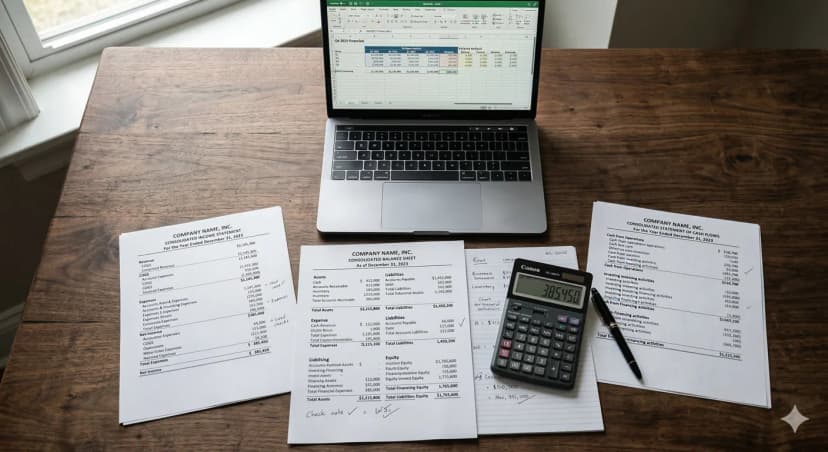
Cash flow projections close that gap. They track when money actually moves in and out of your accounts, not when you earn or owe it. The cash flow statement is one of the three core pro forma financial statements every business plan needs.
Cash Flow vs. Profit: Why They're Different
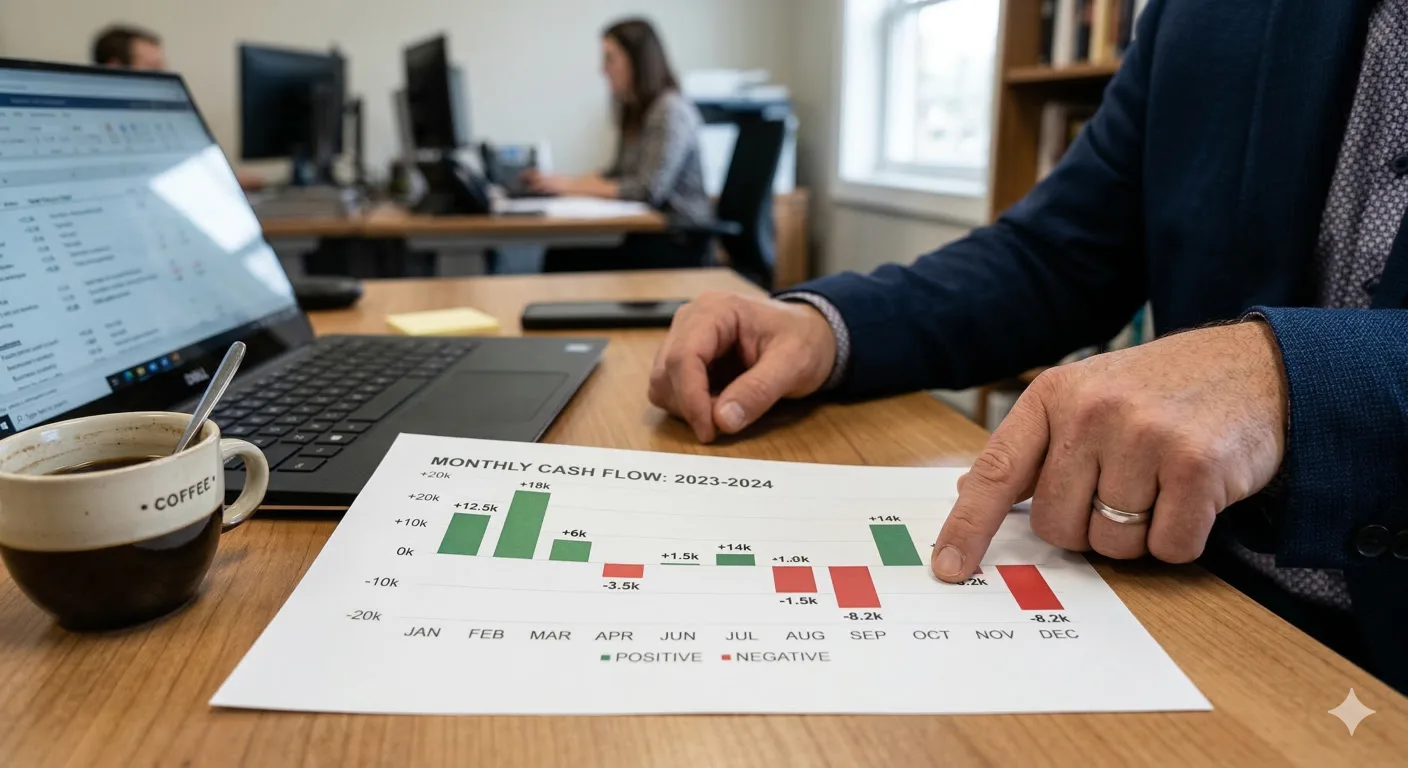
Profit is what your accountant tells you. Cash flow is what your bank balance tells you.
Your income statement records revenue when it's earned (accrual basis). You close a $20,000 deal in March, it shows up as March revenue. But if the client pays in May, you won't see that cash for two months. Meanwhile, you still owe rent, payroll, and suppliers in March and April.
This timing mismatch kills more businesses than bad products do. Not losses on paper. Cash timing.
Three common scenarios where profitable businesses run out of cash:
Rapid growth. You land three big contracts in one month. Great for revenue. But you need to hire staff, buy materials, and start work immediately, while your clients won't pay for 30-90 days. Growth consumes cash before it generates it.
Seasonal businesses. A landscaping company earns 80% of its revenue between April and October. Fixed costs (truck payments, insurance, office rent) run 12 months. Without a cash reserve or credit line sized for the off season, January kills you.
Long payment cycles. Construction, consulting, and B2B services routinely wait 45-90 days for payment. If your average receivable is 60 days and your average payable is 15 days, you're financing 45 days of operations out of pocket on every project.
How to Build a Cash Flow Projection
Step 1: Start with Your Opening Balance
How much cash do you have today? This is your starting point. Every projection builds forward from here.
Step 2: Estimate Cash Inflows
List every source of incoming cash by month:
- Customer payments (not revenue, payments): when will invoices actually be collected? If your terms are net-30, assume 70% pay in 30 days, 20% pay in 45-60, and 10% pay late or require follow up
- Loan proceeds: when disbursements hit your account
- Investment/equity: capital contributions with specific timing
- Other income: interest, asset sales, tax refunds
The most common mistake here is projecting inflows based on when you send invoices rather than when clients actually pay. Use your historical collection data if you have it. If you're a startup, assume slower collections than you expect.
Step 3: Estimate Cash Outflows
List every payment by month:
- Payroll and taxes: your most predictable and usually largest outflow
- Rent/lease payments: fixed, monthly
- Supplier/vendor payments: tied to your payment terms
- Loan repayments: principal and interest by month
- Insurance premiums: monthly or quarterly
- Equipment purchases: one time or financed
- Tax payments: quarterly estimated payments (don't forget these)
Step 4: Calculate Net Cash Flow
For each month: Cash Inflows - Cash Outflows = Net Cash Flow.
Then: Opening Balance + Net Cash Flow = Closing Balance.
That closing balance becomes next month's opening balance. Here's what a simple projection looks like:
| Month | Opening | Inflows | Outflows | Net | Closing |
|---|---|---|---|---|---|
| Jan | $50,000 | $35,000 | $42,000 | -$7,000 | $43,000 |
| Feb | $43,000 | $38,000 | $41,000 | -$3,000 | $40,000 |
| Mar | $40,000 | $52,000 | $44,000 | +$8,000 | $48,000 |
| Apr | $48,000 | $61,000 | $46,000 | +$15,000 | $63,000 |
This business is profitable overall, but January and February are cash negative. Without $50,000 in starting cash, it would have hit zero by February. That's the insight a P&L alone won't give you.
Step 5: Stress Test It
Run a pessimistic scenario: what if 30% of expected payments slip by 30 days? What if your biggest client delays payment for 90 days? What if a supplier demands prepayment?
If your closing balance dips below zero in any scenario, you need to plan for it now: build a larger cash reserve, secure a line of credit, renegotiate payment terms, or adjust your growth pace.
How Far Out Should You Project?
Monthly for 12 months is standard for operating decisions and loan applications. Banks want to see month by month cash flow for at least Year 1.
Weekly for the next 13 weeks if cash is tight. When you're operating with less than 30 days of runway, monthly projections aren't granular enough to catch a midmonth crisis.
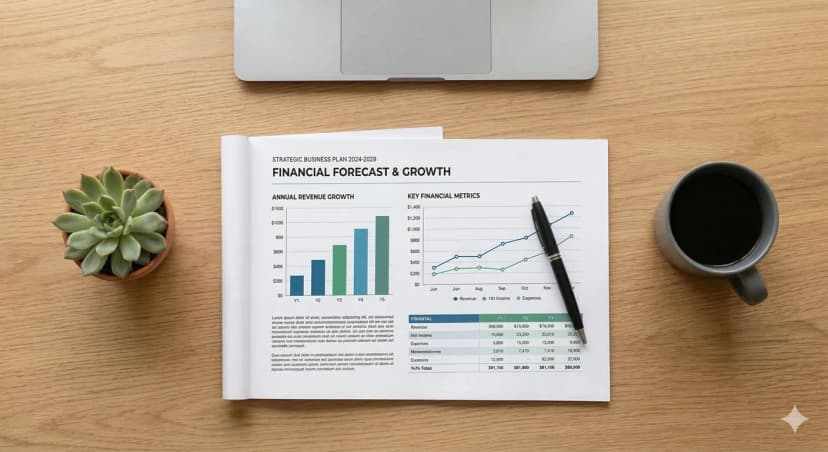
Annual for Years 2-5 for business plans and investor presentations. Less precise, but shows the long term trajectory.
What Lenders Look For
Banks don't just want to see that your business is profitable. They want to see that you can make loan payments every month, including the slow months.
The key metric: debt service coverage ratio (DSCR). Your net operating cash flow divided by total debt payments. Most lenders want 1.25 or higher. That means for every $1 of loan payment, you're generating $1.25 in cash.
If your cash flow projection shows months where you can't cover debt service, a bank will either deny the loan or require additional collateral. Better to know this before you apply. Our bank loan business plan guide covers the full set of lender requirements.
Common Mistakes
Confusing revenue with cash receipts. Your income statement says you earned $50,000. Your bank account has $12,000 in it. Your projection must use cash timing, not accrual timing.
Ignoring seasonality. If your business has a slow season, your projection needs to show it. Flat monthly assumptions when your revenue swings 40% between summer and winter will get caught by any competent lender.
Forgetting one time costs. Equipment purchases, security deposits, licensing fees, and buildout costs hit cash flow hard. These don't show up as monthly operating expenses but they drain your account just the same.
Not updating the projection. A cash flow projection is only useful if it reflects reality. Update it monthly with actual numbers and reforecast from there.
Related Guides
-
Business Plan Examples: 15+ Real Plans by Industry — The complete guide for this topic
-
Business Proposal Template: Free Examples & How to Write One — The complete guide for this topic
-
Marketing Plan Template: Free Download with Examples — The complete guide for this topic
-
Income Statement Template: Free Excel Download with Examples — The complete guide for this topic
-
Business Budget Template: Free Excel Download for Startups — The complete guide for this topic
Build Your Cash Flow Projection
Cash flow projections are a critical section of any business plan, and the key numbers should be highlighted in your executive summary. Building them from scratch means modeling payment timing, seasonal variation, and collection patterns for every revenue stream. PlanArmory's financial projections tool generates linked cash flow statements, income statements, and balance sheets from your business inputs.