Income Statement Template: Free Excel Download with Examples
You know that sinking feeling when you're staring at a blank spreadsheet, trying to figure out how to organize your business finances? Skip the guesswork. An income statement template gives you the exact structure you need to track whether your business is actually making money or just burning through cash.
Download the free Excel income statement template — 12-month tracker with auto-calculated totals, a SaaS startup example, and instructions. No email required.
What's an Income Statement (and Why You Need One)
An income statement shows your revenue, expenses, and profit over a specific period. Think of it as your business's report card for making money. Banks want to see it before approving loans. Investors demand it before writing checks. And you? You need it to know if that new product launch actually helped your bottom line or just created more work.
Unlike a balance sheet that shows what you own and owe at a single moment, an income statement tells the story of how you performed over time. Most businesses create them monthly, quarterly, and annually.
Breaking Down the Income Statement Structure
Your income statement follows a simple formula: Revenue minus Expenses equals Profit (or Loss). But the magic happens in how you organize those categories.
Revenue Section
Start with your total sales or service income. If you sell multiple products or serve different markets, break them out separately. You'll spot trends faster when you can see which revenue streams are growing and which are dying.
Operating Expenses
These are your day-to-day costs of running the business. Group similar expenses together:
- Cost of goods sold (what you pay to make or buy your products)
- Salaries and wages
- Rent and utilities
- Marketing and advertising
- Insurance and legal fees
Non-Operating Items
Interest on loans, investment income, and one-time expenses go here. Keeping them separate from operating expenses shows your core business performance without the noise.
The Bottom Line
After subtracting all expenses from revenue, you get net income. Positive? You're profitable. Negative? You're operating at a loss and need to either increase revenue or cut costs.
Free Income Statement Templates
Here's where you can grab templates that actually work:
Basic Income Statement Template
 Perfect for service businesses and freelancers. Simple categories, automatic calculations, no unnecessary complexity.
Multi-Product Income Statement Best for businesses selling different products or services. Tracks profitability by product line so you know what's worth keeping and what to cut.
SaaS Income Statement Template Built for subscription businesses. Includes MRR tracking, customer acquisition costs, and churn calculations.
Don't waste time building from scratch. Download a template, customize the categories for your business, and start tracking immediately.
Common Income Statement Mistakes to Avoid
Mixing personal and business expenses destroys your ability to see true profitability. That business lunch? Business expense. Your personal Netflix subscription? Not so much.
Ignoring depreciation makes your profits look better than they are. That $5,000 computer doesn't disappear as an expense just because you paid for it last year.
Inconsistent categorization turns analysis into guesswork. Pick categories and stick with them. When you put office supplies under "Administrative Costs" one month and "Operating Expenses" the next, year-over-year comparisons become meaningless.
Real Examples: What Good Income Statements Look Like
A well-organized income statement tells a story at a glance. Take a software company with $100,000 monthly revenue. Their statement might show:
- Subscription revenue: $100,000
- Cost of goods sold (hosting, licenses): $15,000
- Gross profit: $85,000
- Operating expenses (salaries, rent, marketing): $70,000
- Operating income: $15,000
- Net income after taxes: $11,000
Compare that to a retail business with the same revenue but different cost structure. Higher COGS, lower operating expenses, similar net income. The income statement reveals these differences instantly.
Connecting Your Income Statement to Other Financial Documents
Your income statement doesn't live in isolation. It connects directly to your other financial statements:
Need to track where your cash actually goes? Your income statement shows profitability, but cash flow projections reveal whether you'll have money in the bank next month.
Planning next year's expenses? Use your income statement data to build a realistic business budget template based on actual performance, not wishful thinking.
Creating pro forma financial statements for investors? Your historical income statements provide the baseline for credible projections.
For a complete financial picture, many businesses use a profit and loss statement template (which is really just another name for an income statement) alongside their balance sheet and cash flow statement.
Digital Tools vs. Excel Templates
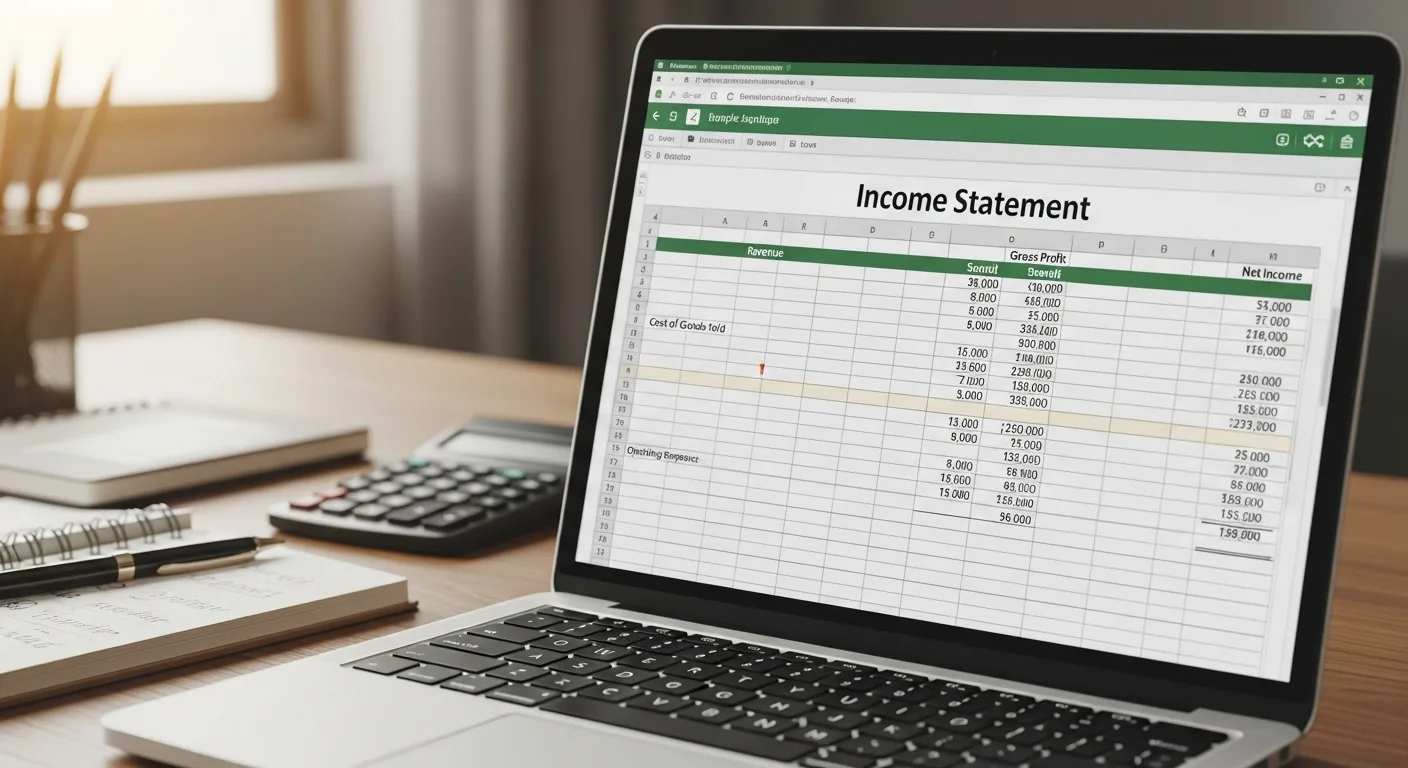
Excel templates work great for most small businesses. They're free, customizable, and don't require monthly subscriptions. But as you grow, consider upgrading to accounting software.
QuickBooks Online starts at $38 per month and automatically generates income statements from your transaction data. No more manual entry. For larger operations, enterprise solutions like Oracle Fusion Cloud EPM run $250 per user monthly but offer real-time analytics and multi-entity consolidation.
The financial services market is exploding, projected to reach $51.11 trillion by 2030. Accounting software alone is expected to hit $30.7 billion by 2029. But you don't need expensive tools to start. A simple Excel template gets you 90% of the value at zero cost.
Making Your Income Statement Work Harder
Your income statement becomes powerful when you use it for decisions, not just compliance. Compare this month to last month. This quarter to the same quarter last year. Spot trends before they become problems.
Set up ratios to track:
- Gross profit margin (gross profit ÷ revenue)
- Operating margin (operating income ÷ revenue)
- Net profit margin (net income ÷ revenue)
When margins shrink, dig into why. Rising costs? Declining prices? New competition? Your income statement holds the clues.
Wrapping Up Your Financial Picture

An income statement template transforms financial chaos into clarity. You'll know exactly where your money comes from and where it goes. Banks and investors get the professional documentation they need. And you make better decisions because you're working with real data, not gut feelings.
Download the free income statement template if you haven't already.
Ready to build your complete financial picture? While your income statement tracks profitability, you'll need comprehensive financial projections to show investors your growth potential. Try PlanArmory's financial projections tool to generate professional forecasts in minutes, not days. Or jump straight into creating a full business plan with our AI-powered generator.