Nonprofits need business plans. This surprises people who think business plans are only for businesses trying to make money. But foundations that write grant checks want to see one. Banks considering your loan application want to see one. Board members voting on your budget want to see one. The ask is always the same: a plan that shows you can deliver your mission without running out of cash.

The IRS doesn't require a business plan to grant 501(c)(3) status. But try getting a $50,000 foundation grant without one. Try opening a line of credit. Try convincing a new board member to join an organization that can't explain its own financial model on paper.
How Nonprofit Plans Differ from For Profit Plans
The standard business plan structure looks similar. The purpose is different.
A for profit business plan exists to show that the business will generate returns for owners or investors. A nonprofit business plan exists to show that the organization can sustain its mission financially. There are no shareholders to pay. There are programs to fund, and the plan needs to prove you can fund them year after year without lurching from crisis to crisis.
Three key differences:
Revenue model. For profit companies sell products or services. Nonprofits typically fund operations through a mix of grants, individual donations, corporate sponsorships, program service fees, government contracts, and fundraising events. Most successful nonprofits don't rely on a single source. If 80% of your revenue comes from one foundation grant, your plan needs to address what happens when that grant ends.
Financial statements. Nonprofits use different terminology. Your income statement is a Statement of Activities. Your balance sheet is a Statement of Financial Position. Revenue is split between "with donor restrictions" and "without donor restrictions." If your plan uses for profit accounting language throughout, it signals that you don't understand nonprofit finance.
Success metrics. A for profit plan measures success in revenue, profit margin, and growth. A nonprofit plan measures success in outcomes: people served, recidivism reduced, meals delivered, students graduated. Your plan needs both pro forma financial projections and impact metrics. Funders want to know that their money actually changes something.
What to Include
Mission and Programs
Start with what you do and who you serve. Be specific about your programs, not just your mission statement. "We fight hunger" is a mission. "We operate two food pantries in Fulton County serving 400 families per week, and a mobile distribution program that reaches 12 rural communities monthly" is a program description.
List each program separately with its target population, geographic scope, and current scale. If you're a startup nonprofit, describe your planned programs with realistic Year 1 targets. "Serving 10,000 families in our first year" without any infrastructure, staff, or partnerships to back it up will get your grant application rejected.
Needs Assessment
Why does your organization need to exist? This is not the place for emotional appeals. It's the place for data.
What specific problem are you addressing? How many people are affected in your service area? What existing organizations serve this population, and where are the gaps? Use data from the Census Bureau, county health departments, school district reports, or published needs assessments from United Way or community foundations.
A funder reviewing your plan already knows the problem exists in general terms. They want to see that you understand the problem in your specific geography with specific numbers.
Organizational Structure
Your legal structure (501(c)(3), 501(c)(4), fiscal sponsorship), governance model, and board composition. List your board members with their professional backgrounds. Funders look at boards carefully. A board of five friends from the founder's social circle signals a different level of organizational maturity than a board with a CPA, an attorney, a program expert, and two community leaders.
Include your staffing plan: who you have now, who you need to hire, and at what cost. Nonprofits routinely underestimate staffing costs. A $45,000 salary costs closer to $55,000-$60,000 after payroll taxes, benefits, and workers' comp. Your budget needs to reflect the real number.
Revenue Strategy

This is where most nonprofit plans fall apart. Listing "grants and donations" as your revenue model is like a restaurant listing "food sales" and calling it a plan.
Break it down by source:
Foundation grants. Which foundations fund work like yours in your region? Name them. What are their typical grant sizes? What's your realistic timeline for applying and receiving funds? Most foundation grants take 3-6 months from application to check, and many foundations only accept applications once per year.
Government funding. Federal, state, and local contracts or grants. These are often the largest funding sources but come with extensive reporting requirements and reimbursement-based payment structures. If you're counting on government funding, your cash flow plan needs to account for the fact that you spend the money first and get reimbursed weeks or months later.
Individual donations. What's your fundraising strategy? Direct mail, online giving, major gifts, planned giving? What's your donor acquisition cost and retention rate? The national average donor retention rate sits in the low to mid 40s (Fundraising Effectiveness Project), which means you lose more than half your donors every year. Your plan should show you understand this math.
Program service fees. Do beneficiaries pay anything? Sliding scale fees, membership dues, ticket sales for events? Many nonprofits generate 30-50% of revenue from earned income rather than donations.
Events. Galas, golf tournaments, walkathons. Be realistic about net revenue. A fundraising event that grosses $100,000 but costs $70,000 to produce is a $30,000 revenue source, not a $100,000 one. Many first year events lose money.
Financial Projections
Funders and lenders read your financials differently than an investor would, but they read them just as carefully.
You need:
- Annual operating budget for the current year, broken out by program and administrative costs
- Three year projected budget showing revenue by source and expenses by category
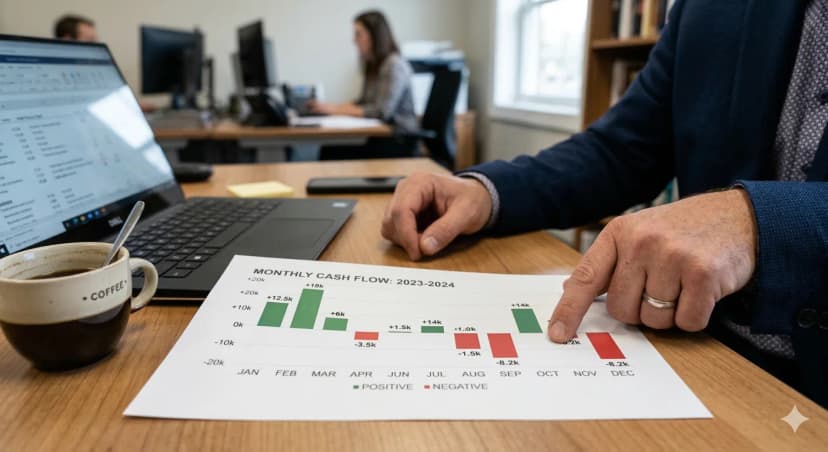
- Cash flow projection showing when funding arrives versus when expenses hit. Grant funded organizations are especially vulnerable to cash timing issues because most grants reimburse after expenses are incurred
- Program cost breakdown showing cost per outcome (cost per meal, cost per student, cost per client served). This is the number funders actually compare across organizations
The program to overhead ratio matters, though not as much as it used to. Charity Navigator and GuideStar have moved away from using overhead ratios as a primary measure of effectiveness. But individual donors still look at it. Keeping administrative costs between 15-25% of total expenses is a reasonable target for most nonprofits. If your plan shows 40% overhead, you'll need to explain why.
If you're applying for a bank loan (yes, nonprofits take out loans for facilities, vehicles, and bridge financing), your plan needs the same financial rigor as any business. Our bank loan business plan guide covers what lenders require. You can also use our nonprofit financial projections tool to generate 5-year income statements, cash flow, and balance sheets tailored to nonprofit operations.
Impact Measurement

How will you know your programs are working? Define your outcomes, not just your outputs.
Outputs are things you do: meals served, classes taught, clients seen. Outcomes are changes that result: food insecurity reduced, employment rates increased, recidivism lowered.
You don't need a PhD level evaluation framework. But you need to define what success looks like, how you'll track it, and how you'll report it. Most foundation grants require at least annual outcome reporting. If you can't measure it, you can't prove it worked, and you won't get funded again.
Marketing and Outreach
How will your target population find you? How will potential donors hear about you? Nonprofits often skip this section because they don't think of themselves as "marketing." But a food pantry that nobody knows about doesn't feed anyone.
For program awareness, focus on the channels that reach your specific population: community health centers, school counselors, social workers, faith organizations, or 211 referral systems. For donor acquisition, cover your approach to online giving, direct mail, major gift cultivation, and event based fundraising. If you're planning a capital campaign, outline the timeline, goal, and quiet phase strategy.
Common Mistakes
Relying on a single funding source. If one grant funds 70% of your operations and it doesn't renew, you're done. Diversify your revenue from day one, even if the initial grants are small.
Ignoring cash flow. A $200,000 government contract that reimburses quarterly means you need $50,000 in working capital to cover expenses between reimbursements. Many nonprofits that look healthy on an annual budget go broke in March because the grant check doesn't arrive until April.
Understating overhead. Every funder knows it costs money to run an organization. Presenting artificially low overhead numbers by hiding admin costs inside program budgets is common, and experienced grant reviewers catch it immediately.
No succession plan. Founder dependent nonprofits are high risk investments for funders. If the founder leaves and the organization can't function, the grant was wasted. Show that the organization's knowledge, relationships, and processes exist beyond one person.
Related Guides
-
Business Plan Examples: 15+ Real Plans by Industry — The complete guide for this topic
-
Small Business Grants: Where to Find Free Funding in 2026 — The complete guide for this topic
Build Your Nonprofit Business Plan
If you're applying for SBA financing for facilities or equipment, our SBA business plan guide covers the additional requirements beyond a standard plan.
Writing a nonprofit business plan from scratch means building program budgets, projecting diversified revenue streams, and documenting impact frameworks. PlanArmory's nonprofit business plan generator produces a complete plan with program descriptions, financial projections, and funding strategy.