How to Start a Pressure Washing Business: Business Plan & Guide
You walk around your neighborhood and see grimy driveways, moldy siding, and concrete that's lost its original color. That's not just an eyesore to it's a business opportunity staring you in the face.
Pressure washing is one of those rare businesses where the demand is literally visible everywhere you look. Property owners need these services, the startup costs won't break you, and you can launch without a college degree or years of training. The U. S. Pressure washing market reached $1.5 billion in 2024 and there are 32,193 businesses in the industry, proving there's plenty of room for newcomers who do the work right.
Skip the research paralysis and start planning. Here's what you need to know to launch a pressure washing business that actually makes money.
Calculate Your Startup Costs (They're Lower Than You Think)
Don't let anyone tell you that pressure washing requires massive upfront investment. You can start this business for $5,000 to $25,000, depending on whether you buy used equipment or go commercial-grade from day one.
Essential Equipment Costs:
- Electric pressure washer: $100 to $500 (perfect for starting out)
- Gas-powered unit: $300 to $1,000+ (better for full-time work)
- Commercial machines: $3,000 to $15,000+ (once you're scaling)
- Cleaning solutions: $100 to $500 for quality chemicals
- Hoses, nozzles, and accessories: $200 to $800
You don't need the fanciest equipment to start. Buy a reliable gas-powered unit around $500-$800, add basic chemicals and accessories, and you're operational for under $2,000 in equipment costs.
Business Setup Costs:
- Business license: $100 to $400 in most states
- General liability insurance: $500 to $1,500 annually
- Commercial vehicle insurance: $1,500 to $2,500 per year
- Basic marketing materials: $200 to $500
Start lean and upgrade as revenue grows. Many successful operators began with a $1,000 pressure washer and built six-figure businesses within two years.
Choose Your Service Focus
Pressure washing isn't just "spray water at dirty things." Different surfaces require different techniques, equipment, and pricing strategies. Pick your lane early instead of trying to do everything.
Residential Services:
- House washing (siding, decks, driveways)
- Concrete cleaning (sidewalks, patios, pool areas)
- Fence and outdoor furniture cleaning
- Pricing: $200 to $500 per residential job
Commercial Services:
- Building exteriors and storefronts
- Parking lots and loading docks
- Fleet vehicle washing
- Restaurant equipment cleaning
- Pricing: $1,000 to $2,500+ per day for commercial work
Commercial contracts pay more but require larger equipment, insurance, and often specific certifications. Residential work is easier to start but caps your daily earning potential. Many operators begin residential and add commercial services once they've built experience and cash flow.
Handle Legal Requirements (Before Your First Job)
You can't just buy a pressure washer and start charging neighbors. Every state has different requirements, and environmental regulations are stricter than most people realize.
Business Registration: Get your business license before marketing. Costs range from $50 to over $500 depending on your state and city. Check if your area requires a contractor's license to California requires one if any job exceeds $500 in cost.
Insurance (Non-Negotiable): General liability insurance costs $750 to $1,500 annually and covers property damage from your equipment. Commercial auto insurance runs $1,500 to $2,500 yearly if you're driving to job sites. Workers' compensation averages $1,600+ per year once you hire employees.
Skip insurance and one equipment malfunction or property damage claim will destroy your business. The annual cost is less than most operators make in a week.
Environmental Compliance: This is where beginners get into trouble. Under the federal Clean Water Act, you can't discharge pollutants into storm drains without authorization. That includes dirty water from pressure washing jobs.
You need proper water recovery systems for many jobs, especially commercial work. Some areas require environmental permits costing $50 to $300. Research local water regulations before your first job, not after an inspector shows up.
Set Your Pricing Strategy
Pressure washing pricing varies wildly because most operators guess instead of calculating actual costs. Know your numbers and you'll outcompete both the lowballers and overpriced competitors.
Hourly vs. Square Foot Pricing: Hourly rates range from $50 to $160 nationally, averaging $78 per hour. Square foot pricing runs $0.15 to $0.75 depending on surface type and job complexity.
Use square foot pricing for standard jobs (driveways, house siding) and hourly rates for complex or unpredictable work. Always include setup, cleanup, and travel time in your calculations.
Market-Rate Examples:
- House washing: $250 to $350 average ($0.08 to $0.44 per square foot)
- Commercial storefront: $0.30 to $0.80 per square foot
- Driveway cleaning: $100 to $300 depending on size and staining
Revenue Potential: Solo operators doing 2-3 residential jobs daily can generate $1,000 to $2,100 in gross revenue. Commercial jobs with larger crews can bring $2,500 to $10,000+ per day. The average U. S. Pressure washing business generates $250,000 annually, though many solo operators make $50,000 to $100,000 working part-time.
Calculate your target annual income, divide by working days, then determine daily job requirements. If you want $75,000 annually working 200 days, you need $375 daily revenue. That's roughly two $200 residential jobs per day.
Create Your Business Plan
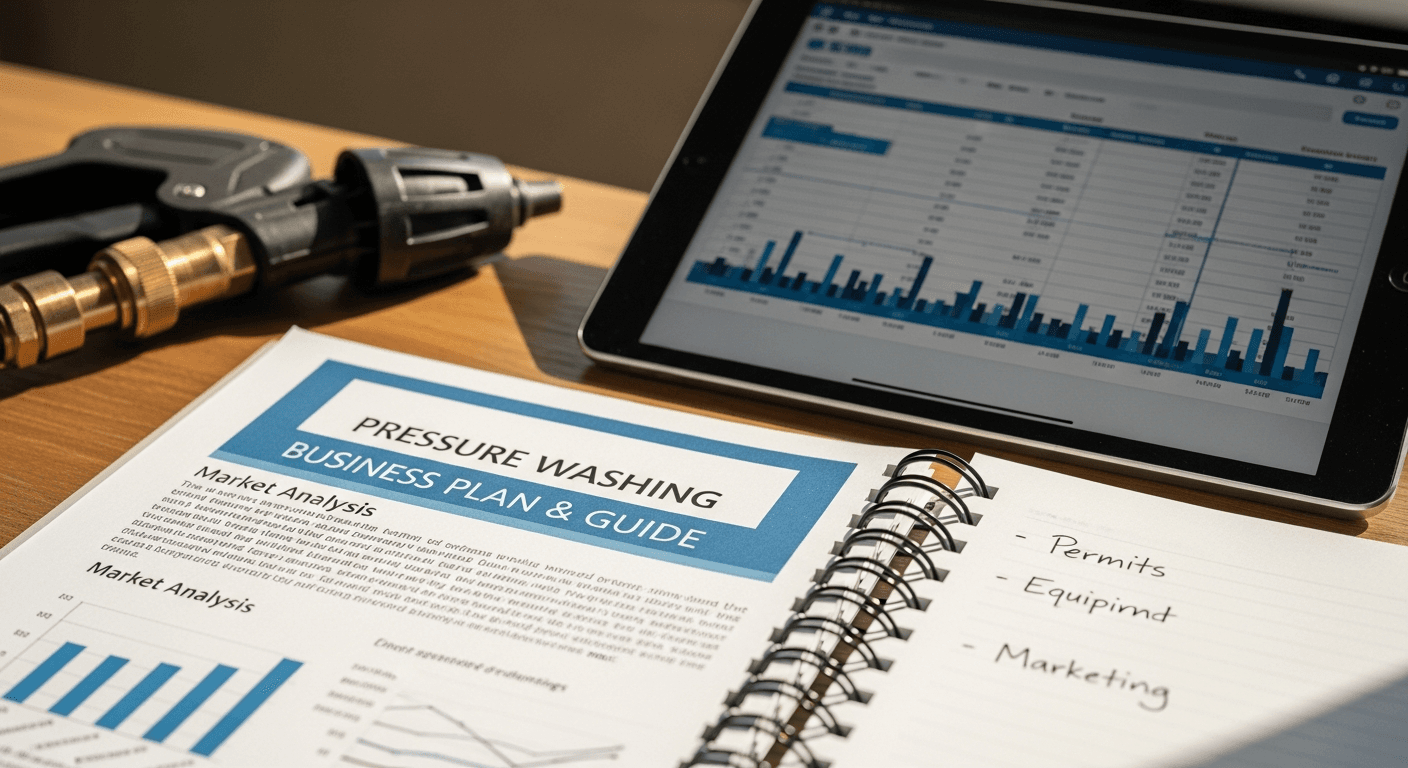
Skip the 50-page business plan template. You need a focused document that covers market research, financial projections, and growth strategy in 15-20 pages.
Market Analysis: Research local competitors' pricing, services, and customer reviews. Drive around target neighborhoods to identify properties that need pressure washing services. Contact commercial property managers to understand their current service providers and pain points.
Financial Projections: Project monthly revenue, expenses, and profit for your first 18 months. Include equipment costs, insurance, fuel (8% of operating costs for most businesses), and marketing expenses. Industry profit margins averaged 6.8% in 2023, but new businesses often see higher margins due to lower overhead.
Growth Strategy: Plan how you'll scale from solo operator to multi-truck operation. Will you hire employees, subcontract work, or stay small? Workers' comp and additional insurance kick in once you hire, so factor those costs into expansion plans.
Many pressure washing businesses break even within 6-12 months of operation. Your business plan should show clear paths to profitability and sustainable growth.
Launch and Scale Your Operations
You've handled the paperwork and bought equipment. Now comes the hard part: finding customers and delivering consistent service.
Customer Acquisition: Start with your immediate network. Offer discounted services to neighbors, friends, and family in exchange for online reviews and referrals. Create social media accounts showcasing before/after photos from every job.
Direct mail still works for pressure washing. Target neighborhoods with homes built 10+ years ago where dirt and grime are visible from the street. Online marketing through Google Ads and Facebook can work, but word-of-mouth referrals drive most successful pressure washing businesses.
Operational Efficiency: Route planning saves time and fuel costs. Book jobs in geographic clusters rather than driving across town between appointments. Batch similar services together to if you're set up for house washing, knock out several in one area before switching to concrete cleaning.
Track your time per job type to improve pricing accuracy. If driveway cleanings consistently take 50% longer than estimated, adjust your rates or processes.
Scaling Decisions: Most successful operators face a choice around year two: stay solo with higher margins or hire help to increase revenue. Solo operators typically max out at $50,000 to $100,000 annually. Adding employees and equipment can push revenue toward $250,000+ but requires management skills and higher insurance costs.
Consider your goals before expanding. A well-run solo operation often provides better work-life balance and net income than a poorly managed multi-employee business.
Related Guides
Build Your Business Plan Today
Starting a pressure washing business isn't complicated, but doing it right requires planning. You need accurate financial projections, competitive analysis, and a clear path to profitability before investing in equipment or marketing.
PlanArmory's business plan generator walks you through industry-specific questions and creates investor-ready financial projections in minutes, not weeks. Answer seven questions about your pressure washing business and get a complete plan with market analysis, startup costs, and growth projections. Start your business plan now and launch with confidence instead of guessing your way to success.