How to Start a Sole Proprietorship: Registration, Taxes & Pros/Cons
You don't need to register with your state to start a sole proprietorship. Skip the paperwork, skip the fees. Start earning money today as the sole owner of your business.
That simplicity is exactly why 86.3% of nonemployer firms choose this structure. But simple doesn't mean you can ignore everything else. You still need the right licenses, tax setup, and legal protections.
Here's what actually matters when starting a sole proprietorship.
What Is a Sole Proprietorship?
You and your business are legally the same entity. That's it. No corporate veil, no separate tax return, no formal registration process. You're personally responsible for everything the business does, good or bad.
Most freelancers, consultants, and small service businesses start as sole proprietorships because there's almost zero friction to begin. About 24.6 million sole proprietorships operate without employees in the US right now.
The trade-off? Your personal assets are on the line if someone sues your business or you can't pay business debts.

How to Start a Sole Proprietorship (The Real Steps)
1. Pick Your Business Name
You can operate under your legal name with zero paperwork. "John Smith Consulting" requires nothing.
Want a different name like "Summit Digital Marketing"? You'll need to file a DBA (Doing Business As) with your county or state. DBA registration typically costs $10 to $100, depending on your state.
2. Get Required Licenses and Permits
This is where people mess up. They think "no registration required" means "no rules apply." Wrong.
You still need:
- Business licenses (varies by industry and location)
- Professional licenses (if you're a contractor, therapist, etc.)
- Sales tax permits (if selling products)
- Home business permits (if working from home)
Business licenses and permits range from $50 to several hundred dollars, depending on regulations. Don't skip this. Operating without proper licenses can shut you down fast.
3. Get an EIN (Optional But Smart)
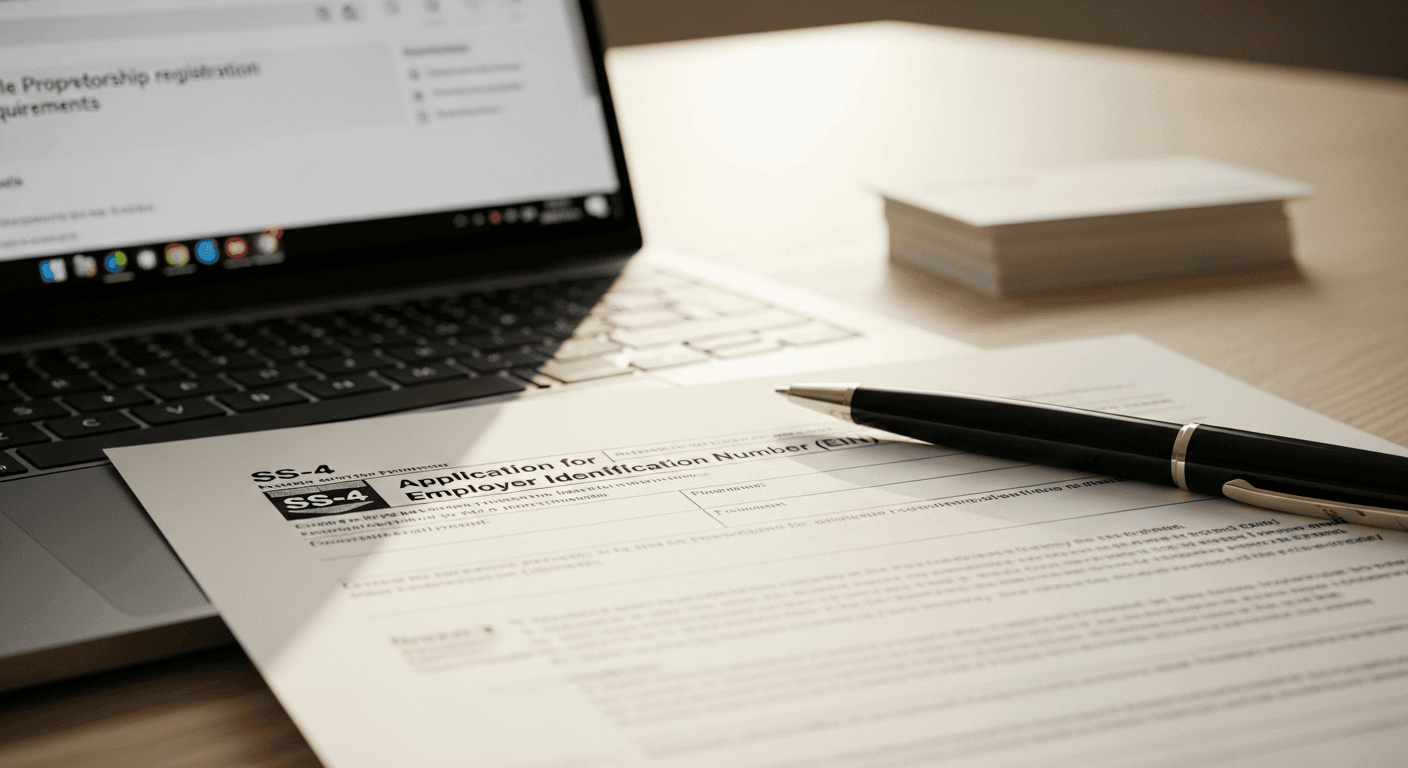
You don't need an Employer Identification Number if you have no employees. You can use your Social Security Number for taxes and bank accounts.
But get an EIN anyway. It's free, takes 10 minutes online, and keeps your SSN off business paperwork. Banks prefer it. Clients expect it.
4. Open a Business Bank Account
You're not legally required to separate business and personal finances as a sole proprietor. Don't care. Do it anyway.
Mixing funds makes taxes a nightmare and destroys any credibility if you're ever audited. Most banks will open a business account with just your EIN and business license.
5. Get Business Insurance
Your homeowner's or renter's insurance won't cover business activities. If a client slips at your home office or you damage their property, you're exposed.
General liability insurance commonly costs between $300 and $1,000 per year, depending on your industry and risk level. Professional liability insurance adds another layer if you give advice or provide services.
Sole Proprietorship Tax Rules
You'll pay two types of taxes: income tax and self-employment tax.
Income Tax
Report business profit and losses on Schedule C, attached to your personal tax return (Form 1040). Your business income gets added to any other income you have, then taxed at your personal rate.
Self-Employment Tax
This hits every sole proprietor hard if they're not ready for it. You'll pay 15.3% on net self-employment income over $400. That's 12.4% for Social Security and 2.9% for Medicare taxes.
For 2024, you'll pay the full 15.3% rate on the first $166,800 of net self-employment income. The Social Security portion stops at $168,600 of combined wages, tips, and net earnings.
QBI Deduction
The Qualified Business Income deduction can reduce your taxable income by up to 20% of your business profits. Income thresholds for 2024 are $182,100 for single filers and $364,200 for joint filers.
Quarterly Estimated Taxes
If you expect to owe $1,000 or more in taxes, you'll need to pay quarterly estimates. Miss these and you'll pay penalties, even if you file on time.
Startup Costs for Sole Proprietorships
Your costs depend entirely on what you're doing:
Low-cost businesses like freelancing or consulting typically require $50 to $500 for essentials. That covers your DBA filing, basic insurance, and maybe a website.
Moderate-cost businesses may need $500 to $3,000 for equipment, marketing, and initial inventory.
Higher-cost businesses often start at $3,000 or more.
In most cases, the total cost to register your business will be less than $300. The real money goes to equipment, inventory, marketing, and working capital.

Pros and Cons of Sole Proprietorships
Pros
- Zero startup paperwork: No state registration required
- Simple taxes: One tax return, no separate business filing
- Complete control: Every decision is yours
- Easy to dissolve: Just stop operating
- Pass-through taxation: No double taxation like corporations
Cons
- Unlimited personal liability: Your house, car, and savings are at risk
- Self-employment tax: 15.3% hits harder than you expect
- Limited growth options: Can't sell equity or bring on partners easily
- Credibility issues: Some clients and vendors prefer incorporated businesses
- No business credit history: Everything ties to your personal credit
When to Consider Other Business Structures
Sole proprietorships work great until they don't. Consider an LLC or corporation if:
- You're worried about lawsuits (contractors, consultants who give advice)
- You want business credit separate from personal credit
- You plan to bring on partners or investors
- You're scaling beyond yourself and need more structure
The good news? You can start as a sole proprietorship and convert later. Many successful businesses begin this way.
What Happens If You Just Start Working Without Setting Up Anything?
You're automatically a sole proprietorship the moment you start earning business income. The IRS doesn't care if you "officially" set up anything.
But that doesn't mean you should wing it. Without proper licenses, insurance, and tax planning, you're setting yourself up for expensive problems down the road.
About 50.8% of new business establishments don't survive past their fifth year according to the latest SBA data. Don't let poor setup be your reason for failure.
Get Your Business Plan in Order
Whether you're starting simple or planning to scale, every business needs a roadmap. A solid business plan helps you think through your target market, competition, and financial projections before you're too deep to pivot.
PlanArmory's AI business plan generator creates investor-ready plans in under 60 seconds. Just answer 7 questions about your business idea and get a complete 20-30 page plan with financial projections and market analysis. Try it free here.